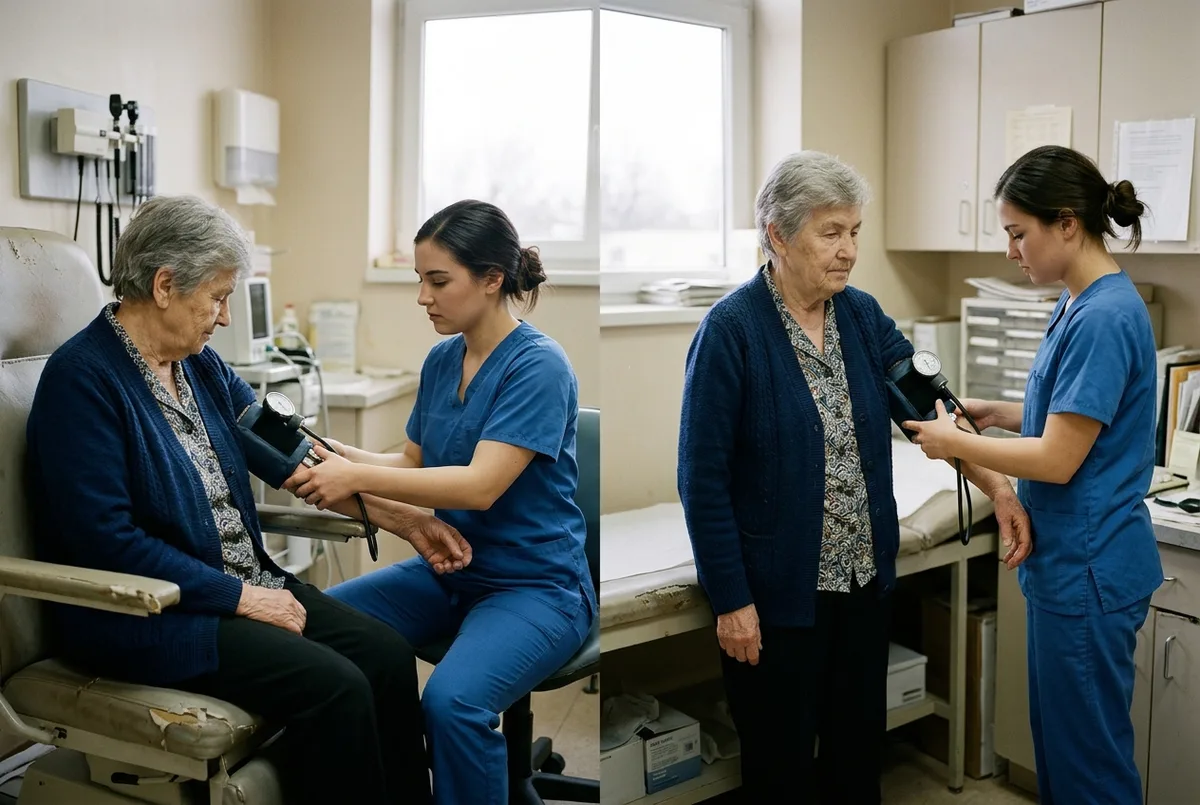
Lifestyle first, check standing, avoid falls
A story from our clinic
A lovely woman in her late 80s has been seeing me for about three years. She has a few health conditions that many people her age share: thinning bones (osteoporosis), a past fall that broke her kneecap, a "mini-stroke" (TIA) some years ago, and high cholesterol.
At a recent follow-up visit, her blood pressure was high. We checked it three times while she was standing, and the readings were about 160/70, 170/80 and 166/72. Her blood pressure did not drop when she stood up, which is good news. She had no chest pain and no new stroke-like symptoms.
In many ways she is doing everything right. Her weight is healthy (BMI around 24). She exercises 30 to 45 minutes regularly. She doesn't drink alcohol. She stays away from salty foods like pickles, French fries and processed foods.
So why was her blood pressure up? Two things stood out when we talked:
- Stress at home. A family member had recently moved into her house, and that change has been hard on her.
- Not enough fruits and vegetables. She was eating very few of them.
What we decided together
I did not rush her onto a new pill. Instead, I asked her to eat fruits and vegetables three times a day. They are rich in potassium and fiber, which help lower blood pressure naturally.
I also gave her a prescription for a blood pressure medicine (amlodipine), with clear instructions: start it only if her blood pressure keeps staying above 150/90. That way she has a plan in hand, but we give the lifestyle change a fair chance first.
Lesson 1: Lifestyle changes still work, even at 80 or 90
Many people think, "At my age, what difference does diet or exercise make?" The answer is: a real and lasting difference. Healthy habits help at every age. Before we start any blood pressure medicine, even in seniors, we always look at:
- Eating more fruits and vegetables
- Cutting back on salt and processed foods
- Staying active, even with gentle walking
- Limiting alcohol
- Managing stress and getting good sleep
These steps have few or no side effects, and the benefits keep going.
Lesson 2: Always check blood pressure standing up
This is the most important message in this blog.
Many older adults have something called orthostatic hypotension, a big drop in blood pressure when they go from sitting or lying down to standing. The word "orthostatic" simply means "upright," and "hypotension" means "low blood pressure."
When blood pressure suddenly drops on standing, less blood reaches the brain for a few seconds. That can cause:
- Dizziness or lightheadedness
- Blurry or "greying out" vision
- Feeling weak or unsteady
- Fainting, and falls
Doctors usually call it orthostatic hypotension when the top number drops by 20 points or more, or the bottom number drops by 10 points or more, within a few minutes of standing.
Why it matters so much: A person's blood pressure might look high while sitting in the doctor's office, but drop sharply when they stand up at home. If we only look at the sitting number and add more medicine, we can make the standing drop much worse, and that leads to falls.
Our patient did not have this problem, but it is very common in seniors.
Watch out after meals, too
After eating, blood flows to the stomach and gut to help with digestion. In some older adults, this causes blood pressure to fall, sometimes by 40 to 60 points. This is called post-meal (postprandial) hypotension. Many falls happen shortly after breakfast or lunch, when someone gets up from the table.
What we do as doctors
For patients over 70, whenever we start a new blood pressure medicine or raise the dose, we:
- Check blood pressure while standing, not just sitting
- Check it more than once
- Ask about dizziness or lightheadedness, and if those symptoms show up, reconsider whether the medicine should continue
What you can do at home
- Get up slowly. Sit on the edge of the bed for a minute before standing.
- Pause after meals before getting up and walking.
- Drink enough water unless your doctor has told you to limit fluids.
- Check your blood pressure at home, both sitting and standing, and bring the numbers to your visit.
- Tell your doctor right away if you feel dizzy, lightheaded or unsteady, especially after a medicine change.
Lesson 3: In seniors, "lower" is not always "better"
Good blood pressure control in older adults is important. It lowers the risk of stroke, heart attack and kidney problems. That matters even more for someone like our patient, who has already had a TIA.
But pushing blood pressure too low, too fast in seniors can cause harm. It can lead to dizziness, falls and broken bones. For someone with osteoporosis, like our patient, a fall can mean a broken hip or another fracture, a long recovery, and loss of independence.
So in seniors, we aim for a balance:
- Low enough to protect against stroke
- Not so low that it causes dizziness and falls
Your goal should be set with your doctor, based on your health, your fall risk and how you feel.
Key takeaways
- Lifestyle comes first, at any age. Fruits, vegetables, less salt, activity and stress management really work.
- Check blood pressure standing up, especially before starting or increasing a blood pressure medicine.
- Be careful after meals. Blood pressure can drop sharply in seniors after eating.
- Don't chase very low numbers. In seniors, gentle control is safer than aggressive control.
- Report dizziness or lightheadedness. It may mean your medicine needs adjusting.
This blog is for general education and is not a substitute for personal medical advice. Please talk to your own doctor before starting, stopping or changing any medicine. Patient details have been kept general to protect privacy.
Related conditions
Book an appointment
Choose a time online with Dr. Vijay Katari, MD at our Frisco or McKinney office, or call (214) 884-2774.